Note to reader: This is going to be a veeeeery casual post (as evidenced by how many “E”s I put in “very”). Please drop all expectations, I plan for this post to be the outlier when it comes to quality. It will contain no meaningful thoughts or calls to action. Enjoy!
Back in 2023, I bought a 2005 Toyota Prius from a guy off craigslist named David for $5.5k. Don’t worry, he was a trustworthy rich hippy who lived on a seaside cliff in Bolinas, CA. Honestly, that Prius has been one of my best purchases of all time.
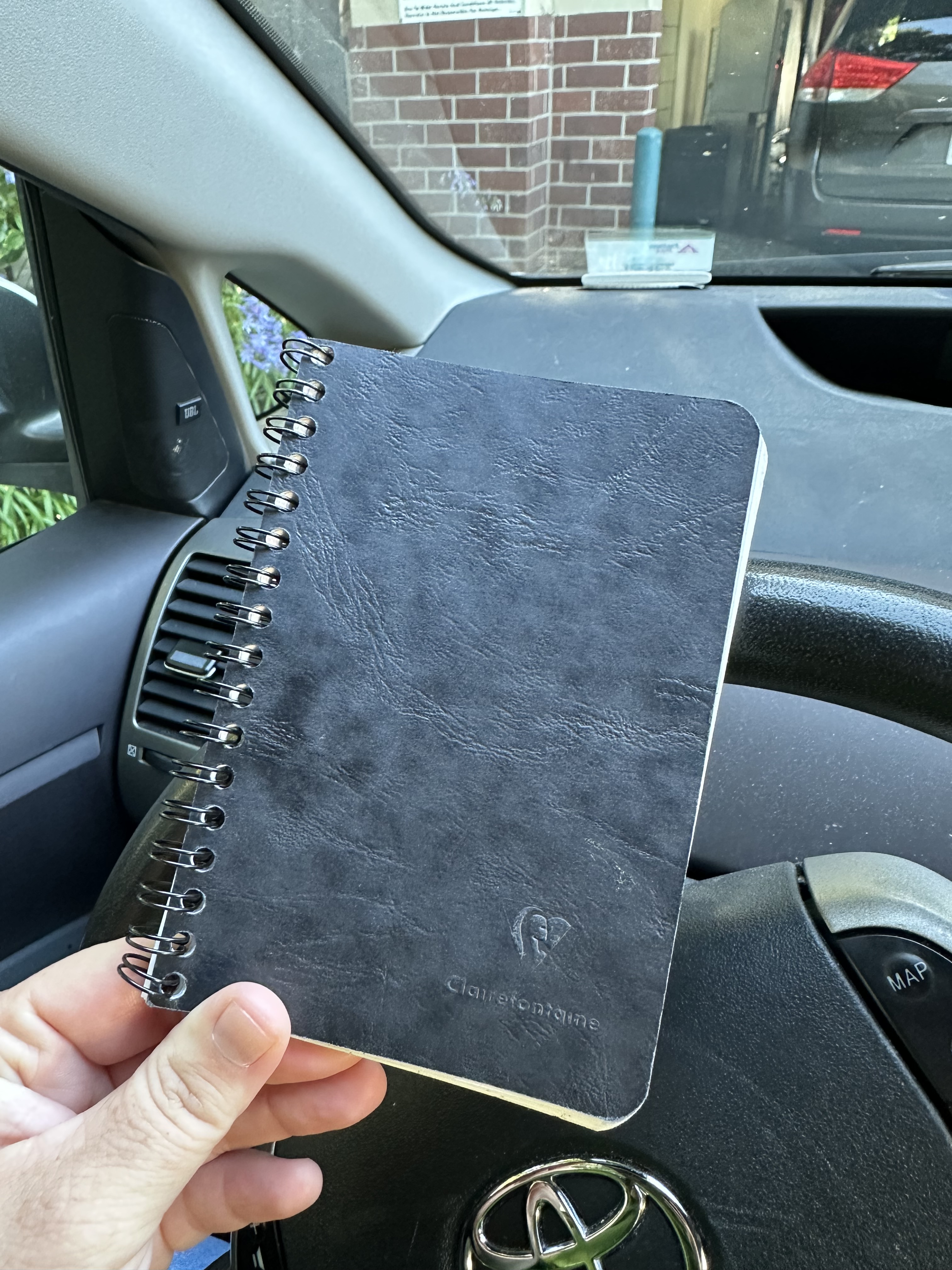
When I met David at his house in Bolinas to pick up the car, he bestowed upon me a small black notebook which contained over a decade of data from the Prius. Since 2012, he has diligently documented every time he filled the tank; noting the date, the odometer, the gallons filled, the cost, and both the car’s automatic calculation of the miles per gallon (MPG) and his own manual calculation. I will say, he was reluctant to give it to me, but his wife who was also with him, made it very clear that the log was not going back into the house. As he hesitantly handed over this historical artifact to me, he asked me to promise him one thing: to keep up the log as the new owner of Prius.
Evidence of the MPG notebook:

I am not sure why I kept a promise to a random seller on craigslist, but here I am two and a half years later, and I have continued his tradition of documenting every single time I have filled up the tank (minus maybe one or two fills). And now that all this time has gone by, I am starting to ask myself…why did I do that??? What is the purpose????
So for my own sanity to justify why I was so diligent in keeping up a strangers gas/mpg log, I decided I am going to analyze the data – for fun! Because… why not? And it actually does sound interesting (at least to me), and it gives meaning to the work that both myself (and David) have completed over the past 13 years. And this is my blog, and you are reading it, so here we are.
If you are interested in playing with the raw data yourself, it can be found here. Please feel free to make a copy and have fun with pointless data yourself! But like my friend David, you have to promise me… if you play with the data, please share your findings with me! I would love to see them (please and thank you!).
I just need you all to appreciate how crazy I have become. Not only did I continue the log, but in order to complete this post, I spent 5 hours transcribing pages of the log into the above excel before someone showed me me how to have ChatGPT transcribe it for me 🥲 And even with the assistance of AI, I reviewed every single entry to make sure it matched the physical log.
Ok, Ok, now on to the analysis:
—
According to the CarFax report, the vehicle was manufactured and shipped to the original dealer on 7/14/2005. This means David, as the second owner of the Prius, began the log when the vehicle was already 10 years old. To my knowledge, there are no entries or MPG data prior to 8/22/2012, which is when (per the CarFax) David purchased the Prius from its first owner. The log was established on 8/19/2012 and to date, there have been 358 entries. Also to note, the pervious owner informed me he replaced the hybrid battery sometime in 2015.
Graph: MPG over time.
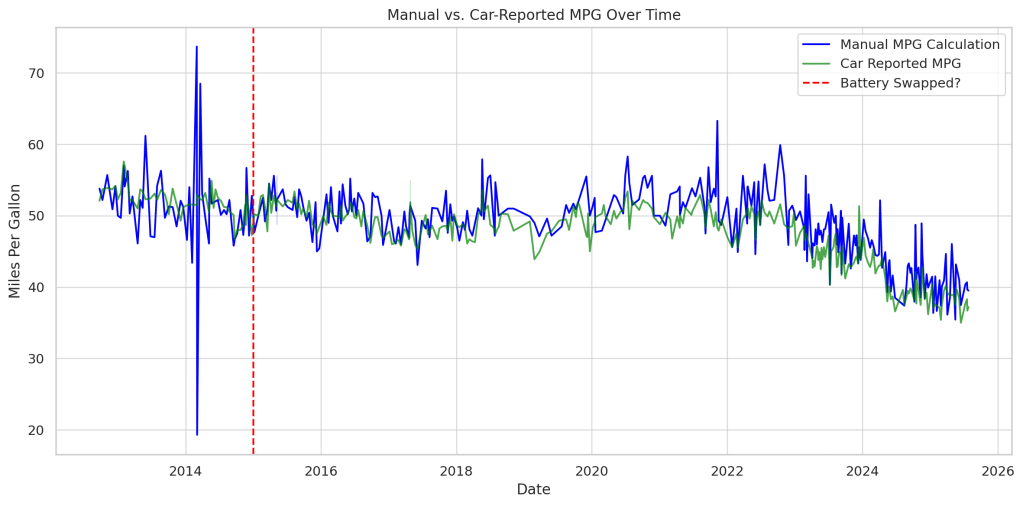
One of the most striking long-term trends in the log is the gradual decline in fuel efficiency. My very first observation in this process was the dramatic decline starting in 2023 (the year I purchased the vehicle). It caused me to pause and wonder why there is such a notable decline the year I purchased it, and what am I doing differently than David that allowed him to maintain a relatively steady MPG over 10 years. Most of my fill-ups since 2023 yielded somewhere in the 43-46 MPG range, with occasional dips into the high 30s.
When the log began in August 2012, the Prius was averaging over 50 miles per gallon, with both the car’s internal computer and David’s manual calculations consistently reporting MPG in the 50-55 range. Even though David stated he replaced the hybrid batter in 2015, I did not observe any changes to the MGP from 2014 to 2016, leading me to believe either the battery was not replaced or the previous battery did not need to be replaced yet, thus leading to no changes in the MPG.
It’s also worth noting that while the car’s internal MPG calculator and the manual calculations are usually within a few points of each other, they do diverge at times, especially in later years. In 2025 the average MPG is 40.09 in my manual calculation, however in contrast, the car reports 38.09 MPG, with most entries from the car reporting under 40. That may be due to rounding inconsistencies or the increasing imprecision of the car’s internal sensors. With a car that is almost old enough to buy alcohol, it makes sense the internal systems are not as accurate or as efficient as they used to be.
Graph: Gas Price Trends (Price Per Gallon)

The second notable story that emerges from the log is the cost of gas itself. When David first began recording entries in 2012, the average price per gallon hovered just above $4.00. However, from 2014-2018, there was a surprising dip in the cost of gas before it started to trend upwards again (with another small dip in 2020-21, which is likely due to COVID). According to the US Energy Information Administration, the drop in 2014 was a result of a “weakening global demand, combined with robust supply from rising U.S. production, decreasing supply disruptions, and the Organization of the Petroleum Exporting Countries (OPEC) maintaining production levels, were the primary causes for the 50% drop in crude oil prices in the second half of 2014.” It is fascinating to see how the log reflected these changes as well (also, I recommend you read the above article, it was actually very interesting).
Beginning in late 2021 and through 2022, prices began to spike rapidly. From 5/12/2022 to 7/5/2022, the log showed each entry exceeded $6.00 per gallon. NPR back in 2022 reported that the dramatic increase in gas prices during that time was due to “the recovery from the pandemic and Russia’s invasion of Ukraine.” By mid-2023 (coincidently when I purchased the Prius), the price began to level off again, but remained elevated compared to the early 2010s.
I am sure there are more observations to be made, and perhaps I will revisit the data with fresh eyes in the future. I actually had a lot of fun diving into the log and finding trends from over 12 years worth of information. For now I leave it to you all, the readers, to help me find more stories in the data!
 The Dagmar Perspective
Leave a comment